
Limiting beliefs: “I’m not good enough”
There is a particular kind of exhaustion that comes from trying to prove you are enough.
Since I was a child, I have been trying to prove that I am enough. For years, I didn’t realise this was what was driving me. I believed I was simply conscientious, hard-working and committed. But underneath was something more fragile. A quiet belief that I kept to myself that I was not, and never would be, as capable as everyone else, and that if I stopped striving even for a moment, I would experience feelings of shame and embarrassment.
This feeling began in early childhood. At the age of eight, when I moved up to middle school, my teachers realised I couldn’t read. On one occasion, I was ridiculed for not knowing the difference between sing and sign. I was placed in special needs lessons, and a school report I recently found stated that I needed to try harder and listen more carefully to instructions, as I was getting my work wrong. It also noted that I had “very neat handwriting, but that this only exposed my spelling mistakes”. I was told by a teacher in high school that “I would never amount to anything”.
I vividly remember spending hours preparing a presentation about the environment in Australia. I stood at the front of the class with an overhead projector (yes, I am that old), I was feeling really proud of what I had created, but that pride was shattered in an instant when the teacher pointed out that I had spelt environment incorrectly. The room seemed to close in. From that point on, I developed a deep fear of anyone reading what I had written. The feelings associated with getting things wrong became overwhelming. Even now, writing blogs feels like a courageous step. The fear has not entirely disappeared, but I no longer allow it to silence me.
Throughout my life, I have worked incredibly hard, yet on many occasions it has not been enough. I failed my final nursing exams and was told that, despite achieving top grades in my clinical placements, I would never be a Bart’s trained nurse. When I said I did not know what to do, as all I had ever wanted was to be a nurse, I was advised to go home. After three years of training, I moved back home with no job and no career. I felt broken.
Eventually, my mum arranged an interview for me at Southampton University, which had copies of all my previous exam papers. Their first comment was, “Did you know you’re dyslexic?” I was twenty-three. That diagnosis was transformative. With the right support and understanding, I excelled when I repeated my training.
Yet despite that success, the old belief lingered. When a belief has been reinforced throughout childhood and early adulthood, it becomes deeply embedded. Achievement alone does not always erase it.
So what happens when we carry a negative belief about ourselves?
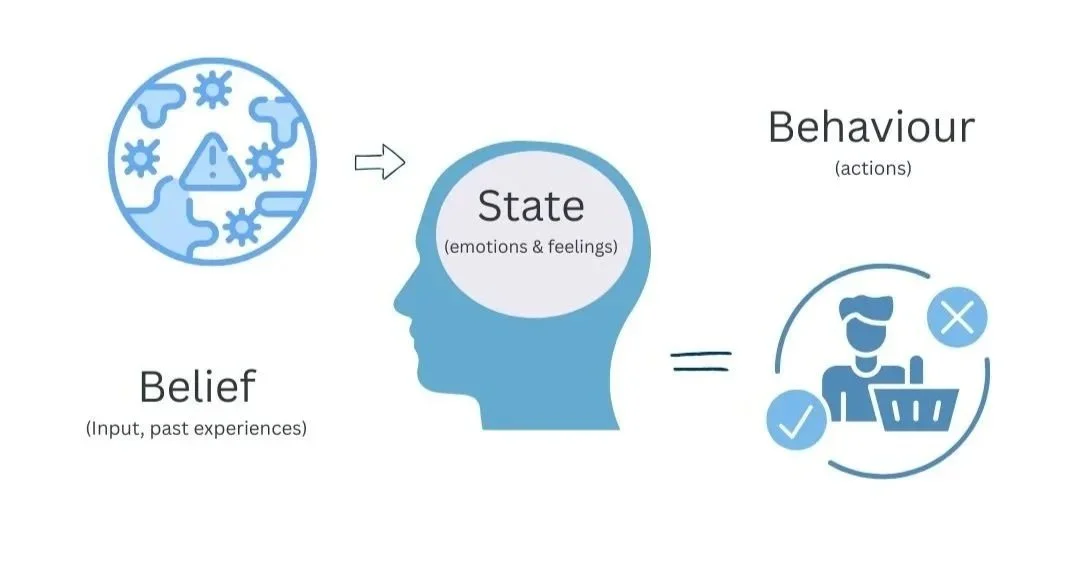
Often, we try harder. We overwork to avoid shame, embarrassment or the feeling of being different. We become perfectionists. We overcommit. We people, please. These behaviours can bring praise and external success, but they also increase the risk of burnout.
The cycle then continues. When we experience anxiety or burnout, we interpret it as further evidence that we are not good enough. We compare ourselves to others. Our negative thoughts intensify. We push even harder.
Alternatively, we avoid. In my case, I avoided writing for many years to protect myself from the discomfort of being judged or exposed.
Limiting beliefs often begin as protective behaviours. They make sense at the time. If I am not good enough, then I must try harder. If I try harder, perhaps I will be safe from criticism. For a while, that strategy works. It can bring achievement, recognition and even success. But it also brings anxiety, chronic over-functioning and a relentless inner critic. It disconnects us from ease and self-compassion. It can drive us into burnout while the world applauds our dedication. We feel like an imposter.
When we believe we are not enough, we outsource our worth. We hinge it on performance, outcomes and validation from others. No amount of achievement ever quite fills the space, because the belief underneath is so deep and often remains unaddressed
The work, I have come to see, is not in striving more. It is in gently examining the story we have been telling ourselves. Questioning the belief and checking its validity. Where is the evidence that I am not good enough? Is that belief based on fact, or on past misunderstanding?
I see how many of us are living from old scripts. We exhaust ourselves trying to fix a feeling that was never truly ours to carry. We change our behaviours without challenging the belief driving them.
If you recognise yourself in this, if you carry a quiet sense of not being quite enough, I invite you to pause. Notice where you are overworking to compensate. Notice where perfectionism is masquerading as high standards. Notice where people pleasing is costing you your own needs. Notice whether exhaustion has become your norm.
Then, gently, question the belief beneath it.
What if you were never not good enough?
What if your story was shaped by incomplete information, painful experiences, or by systems that did not see you clearly for the unique person you are?
We do not heal by berating ourselves into better performance. We heal by bringing curiosity and compassion to the stories we have lived inside.
For me, dyslexia was not a deficit to overcome. It was a missing piece of understanding. It allowed me to reinterpret my past and soften towards that younger version of myself. Her effort was never evidence of inadequacy. It was evidence of determination.
Over the years, I have developed remarkable coping strategies. I think differently. I feel knowledge as much as I process it. My emotional intelligence allows me to connect deeply with others. I can break down complex topics and explain them in a way that feels accessible and human. Dyslexia is no longer something I am ashamed of. It is, in many ways, my superpower.
The belief of not being good enough can drive extraordinary achievement. But it can also quietly erode well-being and lead us to collapse under the weight of our own expectations.
Life doesn’t need to be like this; you can override these limiting beliefs.
You are allowed to be enough without having to prove it.
Sometimes the bravest work we will ever do is not striving harder, but going inwards and rewriting our story.